
The Grid is Now a Deal Term
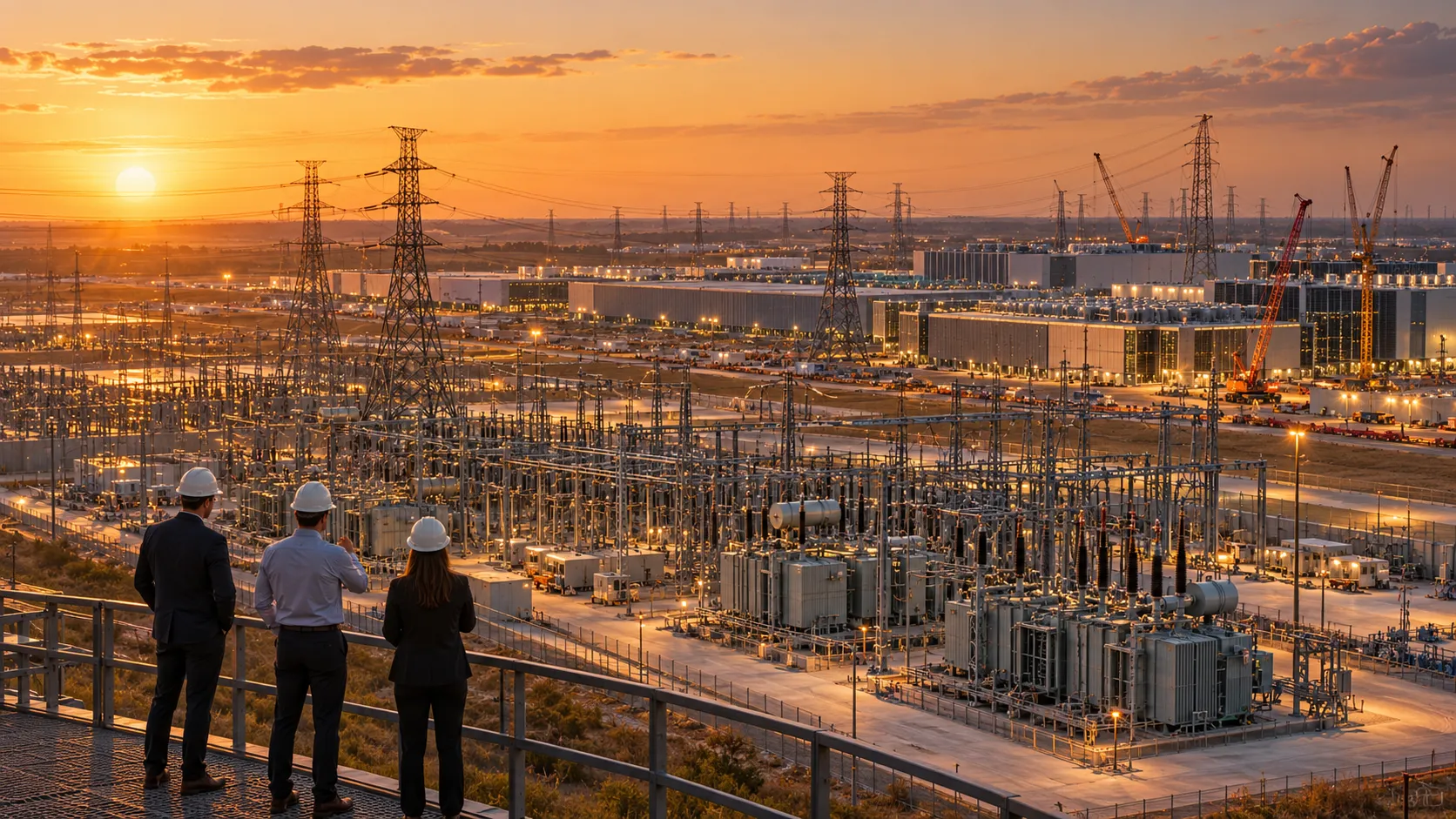
Reshoring, AI and rising power demand are turning electricity availability into a deal term for investors, manufacturers and developers.
A manufacturer can secure the land, order the equipment and raise the capital, yet still be unable to open on schedule. A data center can have a committed customer and a compelling business plan, yet lack a credible date for receiving the power it needs. In either case, the transaction has a missing asset: electricity that can actually be delivered, at the required scale, when operations begin.
That gap changes the deal. Power availability affects whether a site works, when revenue starts, how much capital must remain committed before operations begin and who absorbs the cost if the schedule slips. A cheap parcel with uncertain electrical service can become an expensive investment. A more costly site with a documented path to power can be the better commercial choice.
For founders, private investors, manufacturers and project sponsors, the grid now belongs in the transaction discussion from the beginning. It can determine the economics of the investment before the parties reach the purchase agreement.
The Long Plateau Was Also an Industrial Story
The United States entered the twenty-first century with an electricity system much larger than China’s. China subsequently expanded its industrial base and power system at extraordinary speed, overtaking the United States as the world’s largest electricity generator in 2011, according to the U.S. Energy Information Administration. By the middle of the 2020s, China was producing roughly twice as much electricity as the United States. That reversal is part of the background to today’s competition over manufacturing capacity and advanced computing.
The American experience was different. During the 2000s, substantial portions of manufacturing and their supply chains shifted overseas, while many domestic industrial communities lost factories, jobs and investment. The Bureau of Labor Statistics reports that manufacturing employment declined by almost six million jobs between 2000 and 2010. EIA reports that industrial electricity sales fell 9 percent between 2000 and 2012.
Those figures do not establish that every lost job represented an offshored factory or that offshoring alone caused the electricity plateau. Automation, efficiency improvements, changes in the mix of production and the recessions of that period also mattered. Nor did American manufacturing disappear. The point is that the geography and composition of industrial production changed, and the electricity used to make imported goods was increasingly consumed somewhere else.
A long period of relatively modest domestic demand growth was therefore an imperfect guide to what a new industrial buildout would require. Reshoring semiconductor production, equipment manufacturing and other strategic activities brings physical demands back into the domestic investment equation. Facilities need reliable electrical service as well as capital, workers and customers. China’s power expansion underscores the scale of the task: rebuilding industrial capacity also requires building the infrastructure that can support it.
Reshoring and Compute Are Arriving Together
The timing makes the challenge more consequential. America is seeking to expand strategic manufacturing while AI, cloud services and other computing workloads create another large source of electricity demand. These investments can converge in the same regions, compete for utility capacity and depend on overlapping networks of generation, transmission and substations.
The International Energy Agency reports that data centers accounted for around half of the increase in U.S. electricity consumption in 2025. Its updated global projection sees data-center electricity use roughly doubling from 485 terawatt-hours in 2025 to 950 terawatt-hours in 2030. Those are projections, not guaranteed outcomes, and actual demand will depend on investment, utilization and efficiency. But the financing decisions are being made before that uncertainty is resolved.
For a project sponsor, the immediate question is local. National generating capacity does not establish that a particular utility can deliver a particular load to a particular site. New generation must be available, and the transmission lines, substations, transformers and service arrangements must work together. An industrial strategy that depends on rapid construction needs a credible power-development schedule alongside it.
Available Power Needs a Definition
A statement that a site has “access to power” is too broad to support an investment decision. Existing service may cover a small first phase but not the facility’s full buildout. A preliminary utility discussion may indicate feasibility without reserving capacity. An expected energization date may depend on equipment procurement or infrastructure improvements that remain unfunded.
The parties need to define the required load, the initial and ultimate capacity, the ramp-up schedule and the quality of service the operation needs. They also need to distinguish firm service from arrangements that allow interruption or curtailment. A backup generator can support a particular contingency; it does not automatically solve the economics or operating requirements of continuous production.
The evidence should be specific: utility correspondence, applicable service documents, completed studies, required upgrades, deposits, cost responsibilities and a schedule showing the remaining dependencies. A queue position or favorable preliminary assessment is a step in a process. Its commercial value depends on what still has to happen before the project receives usable service.
Put the Power Schedule into the Deal
Once electricity is central to the business plan, the transaction documents should address the consequences of delay. Otherwise, the parties can agree on an attractive valuation while quietly assuming different answers to the most important operating question.
In a site acquisition or lease, that can mean defined diligence rights, milestones tied to utility progress, an outside date and a workable allocation of upgrade costs. The parties should determine what evidence supports each milestone and what happens to deposits or other committed funds if the required capacity cannot be delivered.
In a financing, the same issue can affect draw conditions, reserves, the timing of equipment purchases and the assumptions used to forecast revenue. Capital committed too early can sit idle while interest and carrying costs accumulate. Capital committed too late can jeopardize procurement or construction. The financing needs to reflect the actual sequence of dependencies.
In an acquisition, buyers should examine whether power arrangements survive a change of ownership, require consents or support the expansion assumed in the price. The existing facility may operate successfully while the next phase depends on upgrades that have never been secured. The underwriting should distinguish current operating capacity from the capacity needed to justify the growth case.
These are commercial allocations to negotiate for the particular project. The useful question is concrete: if power arrives twelve months late, which obligations continue, which payments move, who funds the additional cost and when can a party exit?
Price the Delay Before Signing
Consider two otherwise comparable sites. One has a lower acquisition price but an uncertain path to its required electrical load. The other costs more and has a better-supported service schedule. A price comparison that ignores the power timeline misses delayed revenue, financing costs, equipment storage, customer commitments and the possibility that the project must be redesigned.
The investment case should therefore include a realistic delay scenario as well as the planned opening date. That exercise can change the preferred site, the amount of contingency capital and the terms a sponsor is willing to accept. It can also reveal whether a claimed premium for a “power-ready” asset is justified by enforceable arrangements or rests on optimistic assumptions.
The United States needs additional reliable generation and the infrastructure to move electricity where new industry and computing capacity are being built. That is a national undertaking, but its consequences appear in individual transactions now. The developer choosing a location, the manufacturer planning a new line and the investor financing an expansion all face the same practical constraint.
Capital can fund a project. It cannot, by itself, establish when that project will receive power. Until that date is credible, the operating plan and the valuation remain conditional. The grid is now a deal term.
Filed under

Randy represents businesses throughout the corporate life cycle, from formation and initial capitalization through expansion, acquisitions, public offerings and exit. He also advises investment funds, investors and family offices on investment vehicles, direct investments, governance and ownership arrangements.
MORE FROM SIGNAL
Related reading.
The Contract that Builds the Factory
In the next generation of American industrial projects, long-term customer commitments may be as consequential as the technology or the plant itself. The contracts that unlock capital can also shape an owner’s pricing power, flexibility and eventual exit.
Federal Strategic Capital Is Reshaping Minerals Financing
Federal support for critical minerals is evolving from isolated grants and direct loans into an integrated capital stack that now includes fund-level leverage.